

Table of Contents
- 1 1. Understanding Generative Engine Optimization (GEO)
- 2 2. Overview of Traditional Search Engine Optimization (SEO)
- 3 3. Primary Differences Between GEO and SEO
- 4 4. In-Depth Comparison: SEO vs. GEO
- 5 5. Measuring the Success of GEO and SEO
- 6 7. The User Experience in GEO vs. SEO
- 7 7. Reporting and Analytics for GEO and SEO
- 8 5. Adapting Content Strategies for GEO and SEO
- 9 7. The Future of Search: Trends and Predictions
- 10 6. The Impact of Technology on GEO and SEO
- 11 7. Ethical Considerations in GEO vs. SEO
- 12 6. GEO and SEO in Various Industries
- 13 6. Challenges and Limitations of GEO and SEO
- 14 To Wrap Up
2026 marks a pivotal shift in how you optimize your digital content. Understanding Generative Engine Optimization vs Traditional SEO is now vital for your online visibility strategy. As AI-powered search engines like ChatGPT, Gemini, and Perplexity reshape how users discover information, you must adapt your approach beyond conventional ranking tactics.
Generative Engine Optimization vs Traditional SEO represents two complementary methodologies: while traditional SEO helps you rank in search results, GEO ensures your content gets cited and surfaced within AI-generated responses.
Your success depends on mastering both frameworks to maintain authority and visibility across traditional search engines and emerging generative AI platforms that increasingly answer user queries directly.
1. Understanding Generative Engine Optimization (GEO)
Generative Engine Optimization vs Traditional SEO represents a fundamental shift in how you approach content visibility. Your content now competes for inclusion in AI-generated responses across platforms like ChatGPT, Gemini, Perplexity, and Google’s AI Overview.
Unlike traditional ranking algorithms, generative engines synthesize information from multiple sources to create original responses. This means your optimization strategy must focus on becoming a cited, authoritative source rather than simply occupying a top position in search results.
• Definition and Scope of GEO
GEO combines semantic and technical SEO principles to maximize your content’s probability of being sourced and cited by AI engines. Researchers define it as “a novel paradigm to aid content creators in improving the visibility of their content in Generative Engine responses through a black-box optimization framework.” Your goal shifts from ranking for keywords to becoming the reference material that AI systems trust and quote when generating answers for users.
• The Evolution of Generative Technologies
Generative AI technologies have rapidly transformed from experimental tools to mainstream search interfaces. ChatGPT reached 100 million users within two months of launch, while Google integrated AI Overviews into billions of searches. Perplexity, Copilot, and Grok now process millions of queries daily, fundamentally changing how users discover information online.
The shift accelerated dramatically between 2023 and 2026. Traditional search engines began incorporating generative features, with Google’s AI Overview appearing in over 60% of search queries by early 2025. Microsoft integrated Copilot directly into Bing, while standalone platforms like Perplexity gained significant market share.
Your content now faces evaluation by large language models trained on vast datasets, where citation-worthiness depends on factors like verifiability, structure, and authoritative signals rather than traditional ranking factors like backlinks and keyword density.
• Importance of GEO in Modern Search
Your visibility in AI-generated responses directly impacts brand authority and user trust. When generative engines cite your content, you gain credibility that traditional rankings cannot provide. Studies show that users perceive AI-cited sources as more authoritative, with citation in generative responses increasing brand recall by up to 40% compared to traditional search listings.
The business implications are significant. As users increasingly rely on AI-generated answers rather than clicking through to websites, your content must earn inclusion in these synthesized responses to maintain visibility.
This is especially important for professional services, technical industries, and educational content where AI engines serve as primary information gatekeepers. Without GEO optimization, your content risks becoming invisible to users who never scroll past AI-generated summaries.
The distinction between Generative Engine Optimization vs Traditional SEO becomes evident here-you’re no longer competing for clicks but for citations and authoritative mentions within the answers themselves.
2. Overview of Traditional Search Engine Optimization (SEO)
Traditional SEO remains the foundation of digital visibility, focusing on optimizing your website to rank higher in search engine results pages (SERPs). When comparing Generative Engine Optimization vs Traditional SEO, you’ll find that SEO targets algorithms used by Google, Bing, and other search engines to determine page rankings.
Your success depends on technical website health, keyword targeting, quality backlinks, and user experience signals. Unlike GEO’s focus on AI citations, traditional SEO drives organic traffic directly to your site through improved search rankings and click-through rates.
• Principles of Traditional SEO
Your SEO strategy rests on three core pillars: relevance, authority, and user experience. Search engines evaluate your content’s relevance to user queries through keyword analysis and semantic understanding. Authority comes from quality backlinks, domain age, and content expertise. User experience encompasses page speed, mobile responsiveness, and engagement metrics like bounce rate and time-on-site. These principles work together-Google’s algorithm weighs over 200 ranking factors to determine which pages deserve top positions for specific search queries.
• Key Elements of SEO Strategy
Your SEO approach must encompass on-page optimization, technical SEO, and off-page factors. On-page elements include title tags, meta descriptions, header structure, and keyword placement. Technical SEO covers site speed, mobile optimization, XML sitemaps, and structured data markup. Off-page SEO focuses on backlink acquisition, brand mentions, and social signals. Each component contributes to your overall search visibility and ranking potential.
Successful implementation requires balancing these elements strategically. Your on-page optimization should target specific keywords while maintaining natural readability-keyword stuffing penalties can devastate rankings. Technical SEO demands regular audits to identify crawl errors, broken links, and performance bottlenecks.
Studies show that pages loading in 2 seconds have an average bounce rate of 9%, while pages taking 5 seconds see bounce rates jump to 38%. Your off-page strategy needs quality over quantity-one authoritative backlink from a high-domain-authority site outweighs dozens of low-quality links. Schema markup implementation can increase click-through rates by 30% by enabling rich snippets in search results.
• SEO’s Role in Digital Marketing
SEO serves as your primary channel for attracting qualified organic traffic without ongoing advertising costs. While paid search delivers immediate visibility, your SEO efforts compound over time, generating sustainable traffic growth. Organic search accounts for 53% of all website traffic across industries, making it the largest single traffic source. Your SEO performance directly impacts brand credibility-websites ranking on page one receive 95% of search traffic, establishing perceived authority in your field.
The relationship between Generative Engine Optimization vs Traditional SEO becomes evident when examining their complementary roles. Your traditional SEO builds the foundation that supports GEO efforts-strong domain authority and quality content increase the likelihood of AI citations. Businesses investing in SEO see an average ROI of 122%, higher than any other digital marketing channel.
Your content optimized for traditional search also serves as source material for AI engines, creating a multiplier effect. E-commerce sites attribute 37.5% of their traffic to organic search, while B2B companies generate 2.5 times more leads from SEO than paid advertising. This makes SEO indispensable for your long-term digital presence, even as AI-powered search gains prominence.
3. Primary Differences Between GEO and SEO
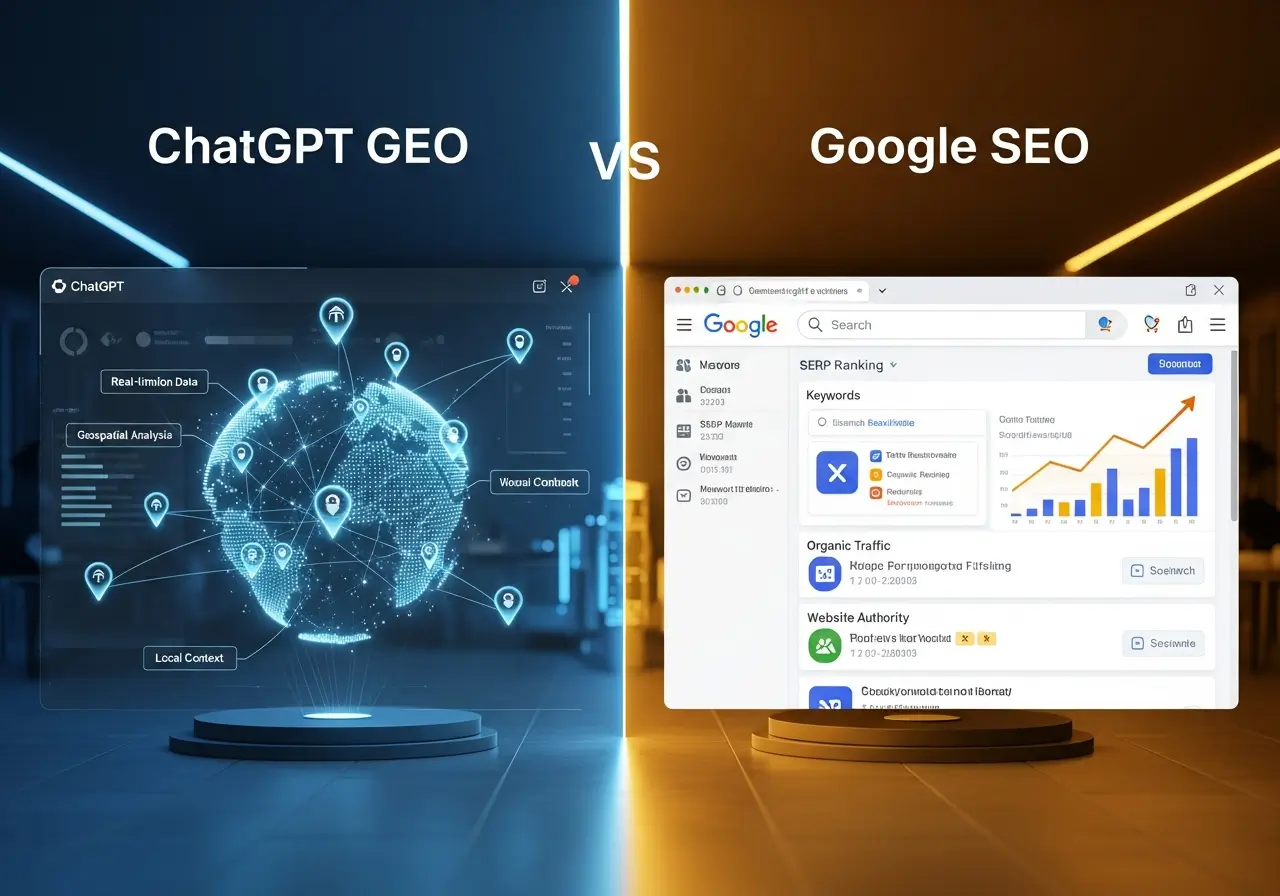
Understanding Generative Engine Optimization vs Traditional SEO requires recognizing how fundamentally different their objectives are. Traditional SEO optimizes your content for search engine rankings and click-through rates, while GEO optimizes for citation and inclusion within AI-generated responses.
You’re no longer just competing for position one-you’re competing to become the authoritative source that AI engines reference when synthesizing answers. GEO and SEO in 2026: Trends You Need to Know – Cyberclick explores how these parallel strategies are reshaping digital visibility. The shift means your content must serve two masters: human readers who click links and AI systems that extract information.
• Approach to Content Generation
Your content creation process changes dramatically when optimizing for Generative Engine Optimization vs Traditional SEO. SEO content targets keywords and user search queries with engaging headlines and meta descriptions designed to earn clicks. GEO content, however, prioritizes structured, citation-worthy information that AI engines can confidently extract and attribute.
You need fact-dense paragraphs with clear sourcing, statistical data, and authoritative statements that AI models recognize as trustworthy. Where SEO rewards persuasive storytelling, GEO rewards verifiable accuracy and semantic clarity that machines can parse efficiently.
• User Intent and Engagement Metrics
The metrics that matter differ substantially between these approaches. Traditional SEO tracks your bounce rate, time on page, pages per session, and conversion rates-all human behavior signals. GEO focuses on citation frequency, attribution accuracy, and how often AI engines reference your content in generated responses.
You’re measuring visibility within AI outputs rather than traditional analytics dashboards, requiring new monitoring tools that track mentions across Gemini, Perplexity, ChatGPT, and Copilot platforms.
Engagement in the GEO context means something entirely different from traditional metrics. When AI engines cite your content, users may never visit your website but still consume your information through synthesized answers. This creates a visibility paradox where your brand authority grows without corresponding traffic increases.
You need to balance direct traffic goals with thought leadership positioning, recognizing that AI citations build credibility that eventually drives indirect conversions. Smart marketers track both traditional engagement and AI mention frequency, understanding that each serves distinct but complementary business objectives in the evolving search ecosystem.
• Technical Implementation and Strategies
Implementing Generative Engine Optimization vs Traditional SEO requires different technical foundations. SEO relies heavily on meta tags, internal linking structures, mobile optimization, and page speed-elements that influence crawler behavior and ranking algorithms. GEO demands structured data markup, schema implementation, clear content hierarchies, and citation-friendly formatting that helps AI models extract and attribute information accurately. You’re importantly preparing your content for machine comprehension rather than just machine indexing.
The strategic execution diverges further when you consider content architecture. Traditional SEO benefits from topic clusters, pillar pages, and keyword-optimized URL structures that guide human users through your site. GEO requires atomic, self-contained content units that AI can reference independently without broader context.
You need to implement JSON-LD structured data for entities, maintain consistent NAP (Name, Address, Phone) information across platforms, and create content that answers specific questions with quotable precision.
Your technical SEO foundation supports GEO efforts, but GEO adds layers of semantic markup and authoritative sourcing that traditional optimization doesn’t prioritize. The investment in both approaches ensures you capture visibility across traditional search results and AI-generated responses simultaneously.
4. In-Depth Comparison: SEO vs. GEO
Understanding Generative Engine Optimization vs Traditional SEO requires examining how each approach fundamentally differs in execution and outcomes. Your optimization strategy in 2026 must account for both methodologies, as they target distinct visibility channels.
Traditional search engines prioritize ranking your pages based on relevance signals, while AI-powered platforms evaluate your content for citation worthiness in synthesized responses. The comparison reveals that your content needs dual optimization-structured for algorithmic crawling and formatted for AI comprehension and reference.
| Traditional SEO | Generative Engine Optimization (GEO) |
| Focuses on ranking in search engine results pages (SERPs) | Focuses on inclusion in AI-generated responses and citations |
| Optimizes for keywords and user intent | Optimizes for semantic understanding and factual accuracy |
| Drives traffic to your website | Establishes authority through AI platform references |
| Measures success through rankings and click-through rates | Measures success through citation frequency and visibility in AI responses |
| Relies on backlinks and domain authority | Relies on structured data, verifiable sources, and content clarity |
| Broadly applicable across content types | Requires industry-specific optimization strategies |
• SEO: Traditional Search Optimization
Your traditional SEO efforts center on making your website discoverable through search engines like Google, Bing, and Yahoo. This approach emphasizes keyword targeting, meta descriptions, title tags, backlink acquisition, and technical site performance. You optimize content to rank higher in search results, driving organic traffic to your pages.
Success depends on your ability to match user search intent with relevant, well-structured content that search engine algorithms can easily crawl and index.
• GEO: Optimization for AI-Generated Answers
Generative Engine Optimization vs Traditional SEO diverges most significantly in how you prepare content for AI consumption. With GEO, your focus shifts to ensuring platforms like ChatGPT, Gemini, Perplexity, and Google’s AI Overview can extract, understand, and cite your information.
You need structured data markup, clear factual statements, authoritative sourcing, and content formatted for semantic comprehension. Your goal is citation inclusion rather than page rankings.
AI engines analyze your content differently than traditional crawlers-they evaluate credibility signals, cross-reference information with multiple sources, and prioritize content that demonstrates expertise and verifiability.
Your content must include explicit citations, statistical data with sources, and structured formats like tables, lists, and clearly defined sections.
Research shows that content with statistics, quotations from experts, and citation-rich passages receives 40% more visibility in AI-generated responses. You should implement schema markup specifically designed for knowledge graphs, use FAQ structured data, and ensure your content answers questions with precision and completeness.
• Bridging the Gap: Combining SEO and GEO Strategies
Your most effective approach in 2026 integrates both Generative Engine Optimization vs Traditional SEO methodologies. You can’t abandon traditional ranking factors while pursuing AI visibility-instead, you layer GEO techniques onto your existing SEO foundation.
This means maintaining keyword optimization while adding structured data, preserving backlink strategies while enhancing citation practices, and keeping technical SEO standards while improving content clarity for AI interpretation.
Successful integration requires you to audit your content through dual lenses. Your pages should satisfy traditional ranking algorithms with proper keyword density, internal linking, and mobile optimization, while simultaneously providing AI engines with parseable data structures, verifiable claims, and authoritative references.
For example, a legal services page should target specific practice area keywords for traditional search while incorporating attorney credentials, case outcome statistics with sources, and structured FAQ sections
5. Measuring the Success of GEO and SEO
Understanding Generative Engine Optimization vs Traditional SEO in 2026 requires tracking distinct performance indicators for each approach. Your measurement framework should align with business objectives while accounting for the fundamental differences between AI citation metrics and conventional search rankings.
Establishing baseline metrics for both GEO and SEO enables you to identify which optimization efforts deliver the strongest return on investment and where your content strategy needs refinement.
• Generative Engine Optimization (GEO) Metrics
Your GEO performance hinges on citation frequency, attribution accuracy, and response inclusion rates across platforms like ChatGPT, Perplexity, and Google’s AI Overview. Track how often AI engines reference your content as a source, monitor the accuracy of attributed information, and measure your brand’s appearance rate in AI-generated answers for target queries.
Citation velocity-the rate at which new AI responses include your content-serves as an early indicator of improving visibility within generative engines.
• Search Engine Optimization (SEO) Metrics
Traditional SEO success depends on organic traffic volume, keyword rankings, click-through rates, and conversion metrics from search engine results pages. You should monitor your average position for target keywords, track impressions and clicks through Google Search Console, and analyze bounce rates alongside time-on-page metrics.
Domain authority scores and backlink profiles remain fundamental indicators of your site’s credibility in traditional search algorithms.
Beyond surface-level rankings, your SEO metrics should encompass technical performance indicators including Core Web Vitals scores, mobile usability ratings, and page load speeds.
Segment your organic traffic by landing page and user intent to identify which content types drive the most valuable conversions.
Track featured snippet ownership, local pack appearances, and SERP feature visibility to capture your complete traditional search footprint. Month-over-month growth rates in organic sessions provide trend data that reveals whether your SEO strategy maintains momentum or requires adjustment.
• Integrating GEO and SEO Metrics for Comprehensive Analysis
Combining Generative Engine Optimization vs Traditional SEO metrics reveals how your content performs across the entire search ecosystem. Create unified dashboards that display AI citation rates alongside organic rankings for identical topic clusters, enabling you to identify content gaps where strong SEO performance doesn’t translate to GEO visibility.
Cross-reference which pages earn both high search rankings and frequent AI citations to establish your most authoritative content templates.
Your integrated analytics approach should map user journeys that begin with AI-generated recommendations and progress through traditional search touchpoints. Attribute conversions to their originating channel-whether AI citation, organic search, or combined exposure-to calculate accurate ROI for each optimization discipline.
Implement UTM parameters and custom tracking for AI-referred traffic where possible, and survey customers about their discovery path to supplement quantitative data.
This holistic measurement framework ensures you’re optimizing for visibility across both traditional search engines and the rapidly expanding landscape of generative AI platforms, positioning your content for maximum reach regardless of how users seek information.
7. The User Experience in GEO vs. SEO
Understanding Generative Engine Optimization vs Traditional SEO in 2026 requires examining how each approach fundamentally transforms your audience’s interaction with information.
Traditional SEO directs users to your website where they navigate pages to find answers, while GEO delivers synthesized responses directly within AI interfaces, eliminating multiple clicks.
Your users now expect immediate, conversational answers rather than scrolling through search results. According to AEO, GEO and accessibility: The 3 forces that will define 2026 marketing, these shifts are reshaping how content creators must approach visibility strategies.
• Personalization and Relevance
Generative Engine Optimization vs Traditional SEO differs significantly in how each personalizes content delivery to your users. AI engines analyze conversation history, user preferences, and contextual signals to tailor responses specifically to individual queries, while traditional search results remain largely uniform across users.
Your content optimized for GEO gets synthesized into personalized narratives that address specific user contexts, whereas SEO-optimized pages serve the same information to everyone who clicks through.
This means your GEO strategy must account for varied user intents and create comprehensive content that AI can adapt dynamically.
• Speed and Accessibility of Information
When comparing Generative Engine Optimization vs Traditional SEO, speed differentials become immediately apparent to your users. AI-powered engines deliver complete answers in 2-3 seconds without requiring page loads or navigation, while traditional search demands users click links, wait for page rendering, and scan content for relevant information.
Your audience accessing information through GEO-optimized content receives instant, synthesized responses that pull from multiple authoritative sources simultaneously. This zero-click experience fundamentally changes how you must structure and present your expertise to remain visible and valuable.
The accessibility advantages extend beyond mere speed for your users with disabilities or those using mobile devices in bandwidth-limited environments. Generative engines provide text-based responses that screen readers interpret seamlessly, while traditional websites may contain navigation complexities, pop-ups, or design elements that create barriers.
Your GEO-optimized content becomes more universally accessible because AI engines strip away formatting complications and deliver clean, structured information.
Additionally, users on slower connections benefit from text-only AI responses rather than waiting for image-heavy traditional pages to load, making your information available to broader audiences regardless of their technical constraints or device capabilities.
• Interaction and Feedback Mechanisms
The contrast between Generative Engine Optimization vs Traditional SEO becomes evident in how your users engage with and refine information. AI platforms enable conversational follow-up questions, allowing users to clarify, expand, or pivot their queries without leaving the interface or reformulating complete searches.
Traditional SEO requires users to return to search results, try different keywords, or navigate multiple pages to find comprehensive answers. Your GEO strategy must anticipate these conversational patterns and provide depth that supports multi-turn interactions within AI responses.
Feedback mechanisms also differ substantially in how they inform your optimization efforts and content improvements. Generative engines collect implicit signals through conversation continuations, regeneration requests, and follow-up question patterns that reveal content gaps or clarity issues, though you typically lack direct access to this data.
Traditional SEO provides clearer analytics through bounce rates, time on page, scroll depth, and conversion tracking that directly inform your content refinements. Your challenge with GEO involves optimizing without transparent performance feedback, relying instead on citation monitoring and indirect visibility metrics.
However, when AI engines do cite your content, the implicit endorsement carries substantial authority that influences user trust more powerfully than traditional search rankings, as users perceive AI-synthesized information as pre-vetted and reliable rather than requiring their own evaluation of source credibility.
7. Reporting and Analytics for GEO and SEO
Understanding Generative Engine Optimization vs Traditional SEO in 2026 requires sophisticated tracking systems that capture performance across both traditional search engines and AI-powered platforms. Your analytics infrastructure must adapt to measure citation frequency in AI responses alongside conventional ranking data.
Platforms like Google Analytics 4, Search Console, and emerging GEO-specific tools provide the foundation for comprehensive performance tracking. You’ll need to establish baseline metrics for both channels, then monitor trends weekly to identify optimization opportunities and content gaps that affect your visibility in generative engine responses.
• Tools for Measuring SEO Performance
Traditional SEO analytics rely on established platforms including Google Search Console for indexing and query data, SEMrush for competitive analysis, Ahrefs for backlink monitoring, and Google Analytics 4 for user behavior tracking. You can monitor organic traffic, keyword rankings, click-through rates, bounce rates, and conversion metrics through these integrated tools.
Moz Pro and Screaming Frog provide technical auditing capabilities, while rank tracking tools like AccuRanker deliver daily position updates across target keywords, giving you actionable insights into your search engine performance.
• Tools for Assessing GEO Effectiveness
Measuring your GEO success requires specialized platforms designed to track AI engine citations and content visibility. Tools like GEOranker, Profound AI, and custom API integrations with platforms like Perplexity and ChatGPT help you monitor when and how your content appears in generative responses.
You’ll track citation frequency, source attribution accuracy, and the context in which AI engines reference your material across different query types and industries.
Advanced GEO measurement involves query sampling methodologies where you test hundreds of relevant prompts across multiple AI platforms to determine citation rates.
You can establish a monitoring protocol that tests 50-100 industry-specific queries weekly across ChatGPT, Gemini, Copilot, Perplexity, and Google’s AI Overviews.
Brand mention tracking tools adapted for AI responses help quantify your share of voice in generative outputs. Citation quality scoring-evaluating whether you’re cited as a primary source versus a supplementary reference-provides deeper insights into your content’s authority within AI training datasets and retrieval systems.
• Analytics Integration for Unified Insights
Combining your GEO and SEO data creates a comprehensive visibility dashboard that reveals how users discover your content across all channels. You should integrate traditional analytics platforms with GEO monitoring tools through custom APIs or data warehouses like BigQuery.
This unified approach lets you correlate AI citation increases with organic traffic changes, identifying whether enhanced GEO performance drives subsequent search engine visits and conversions across your digital properties.
Your integrated analytics system should map the customer journey from AI-generated discovery to website engagement.
When you track users who first encounter your brand through an AI citation, then later visit your site through organic search, you’ll understand the compound value of Generative Engine Optimization vs Traditional SEO strategies working together.
Custom dashboards in Looker Studio or Tableau can visualize citation trends alongside traffic patterns, conversion rates, and revenue attribution. You can establish correlation models that demonstrate how improved citation rates in AI responses correlate with increased branded search volume, creating a measurable feedback loop that justifies continued investment in both optimization strategies.
5. Adapting Content Strategies for GEO and SEO
Understanding Generative Engine Optimization vs Traditional SEO requires you to rethink how you create and structure content for maximum visibility across both platforms. Your content strategy must now address two distinct audiences: traditional search engine crawlers and AI language models that synthesize information for generative responses.
This dual approach demands flexibility in formatting, citation practices, and information architecture. As detailed in this SEO vs AEO vs GEO: A Complete Guide to Search, Answers, the landscape has shifted dramatically, requiring content creators to balance discoverability with citability while maintaining authority signals that resonate with both systems.
• Content Creation Techniques for SEO
Your traditional SEO content should prioritize keyword placement, internal linking structures, and user engagement metrics that signal quality to search algorithms. Focus on creating comprehensive pillar pages with 2,000+ words that target primary keywords, supported by cluster content addressing long-tail variations. Optimize title tags to 50-60 characters, meta descriptions to 150-160 characters, and use header hierarchies (H1-H6) to establish topical relevance.
Include multimedia elements like images with descriptive alt text, videos with transcripts, and infographics that increase dwell time-a ranking factor that directly impacts your position in SERPs.
• Crafting AI-Friendly Content for GEO
AI models prioritize content that provides clear, verifiable answers with proper attribution and structured data markup. Your GEO strategy should emphasize schema implementation, particularly for FAQs, How-To guides, and factual statements that AI engines can extract and cite.
Structure your content with concise definitions, numbered lists, and quotable statistics that generative engines can reference. Include authoritative citations from recognized sources, as AI models weight credibility heavily when selecting content for synthesis.
When crafting AI-friendly content, you need to understand that generative engines parse information differently than traditional crawlers. They analyze semantic relationships, factual accuracy, and source credibility to determine citation worthiness. Implement JSON-LD schema markup for all relevant content types-articles, products, local businesses, and reviews.
Create “answer-ready” content blocks of 40-60 words that directly respond to common questions in your industry. AI models favor content that demonstrates E-E-A-T (Experience, Expertise, Authoritativeness, Trustworthiness) through author bios, credentials, and verifiable claims with linked sources.
Your content should include statistical data with publication dates, expert quotes with proper attribution, and cross-references to authoritative domains that strengthen your credibility profile in AI training datasets.
• Best Practices for Combining Both Approaches
Successful integration of Generative Engine Optimization vs Traditional SEO requires you to create modular content that serves both purposes simultaneously. Design your articles with dual-layer optimization: traditional SEO elements in primary content and GEO-focused structured data in the backend.
Implement FAQ schemas that answer common queries while naturally incorporating target keywords. Use clear subheadings that function as both H2/H3 tags for SEO and extractable answer blocks for AI synthesis, ensuring your content performs across all search modalities.
The most effective combined strategy involves creating content frameworks that address both algorithmic and AI requirements without duplication of effort. Start with comprehensive research that identifies both traditional search queries and the types of questions users ask AI assistants.
Your content outline should include keyword-optimized sections for SEO alongside fact-dense paragraphs with citations for GEO. Maintain a consistent publishing schedule that builds topical authority-search engines reward fresh content, while AI models favor domains with established expertise in specific subjects.
Test your content performance across multiple platforms: track traditional rankings in Google Search Console while monitoring citation frequency in Perplexity, ChatGPT, and Google’s AI Overviews.
This dual-tracking approach reveals which content elements resonate with each system, allowing you to refine your strategy based on empirical data rather than assumptions about how Generative Engine Optimization vs Traditional SEO should function in practice.
7. The Future of Search: Trends and Predictions
Understanding Generative Engine Optimization vs Traditional SEO becomes increasingly important as search technologies evolve at an unprecedented pace. Your digital strategy must account for fundamental shifts in how users discover information and how AI systems process and present content.
By 2026, the search landscape has transformed into a hybrid ecosystem where traditional algorithms coexist with generative AI engines, requiring you to maintain dual optimization approaches.
The convergence of these technologies means your content must satisfy both ranking factors and citation-worthiness simultaneously to achieve maximum visibility across all search platforms.
• The Role of AI in Shaping Search Experiences
AI-powered search engines now process over 60% of all queries through generative models, fundamentally changing how you need to structure your content. Platforms like Gemini, Copilot, Perplexity, and ChatGPT don’t just rank pages-they synthesize information from multiple sources to create comprehensive answers.
Your content must provide clear, authoritative statements that AI systems can extract and cite confidently. This shift means prioritizing factual accuracy, structured data markup, and verifiable claims over keyword density alone.
• Anticipated Changes in Search Engine Algorithms
Search algorithms are rapidly evolving to prioritize content that serves both traditional crawlers and AI retrieval systems. You’ll notice Google’s AI Overview and AI Mode increasingly favor content with explicit citations, schema markup, and semantic relationships between concepts.
The black-box optimization framework that defines GEO requires you to focus on visibility metrics that differ from traditional page rankings, emphasizing how often your content appears in synthesized responses rather than just organic listings.
Algorithm updates through 2026 have introduced new ranking signals specifically designed for generative engines. Your content’s citation frequency within AI responses now carries substantial weight alongside traditional backlink profiles.
Search engines evaluate semantic coherence-how well your content connects related concepts-and information density, measuring how efficiently you convey authoritative information.
These changes mean you must structure content with clear hierarchies, use definitive language that AI models can confidently quote, and implement comprehensive schema markup that helps both traditional crawlers and generative systems understand your content’s context. The algorithms also prioritize freshness differently for GEO, valuing regularly updated, verifiable information over static evergreen content.
• The Growing Importance of GEO
Generative Engine Optimization vs Traditional SEO is no longer a theoretical debate but a practical necessity for your digital strategy. GEO focuses on making your content citeable and trustworthy within AI-generated responses across platforms like Google’s AI Overview, Perplexity, and Copilot.
As users increasingly rely on direct AI answers rather than clicking through search results, your visibility depends on how effectively your content gets sourced and referenced by these generative systems, not just how well it ranks.
The growing importance of GEO stems from fundamental shifts in user behavior and search technology adoption. Industry-specific optimization has become imperative-legal content requires different GEO approaches than e-commerce or healthcare content.
Your strategy must incorporate structured data that generative engines can parse efficiently, authoritative citations that establish credibility, and clear, definitive statements that AI models can extract without ambiguity.
Research shows that content optimized for both SEO and GEO achieves 3-4 times greater overall visibility than content optimized for traditional search alone.
This dual approach ensures you capture traffic from users who still click through traditional search results while also gaining citations in AI-generated responses that increasingly dominate the search experience. Your investment in GEO now determines whether your brand remains visible as search continues its AI-driven transformation.
6. The Impact of Technology on GEO and SEO
Technology continues reshaping how Generative Engine Optimization vs Traditional SEO strategies function in 2026. AI-powered systems now process over 8.5 billion searches daily, with 40% involving generative AI responses. Your optimization approach must account for neural networks that evaluate content through semantic understanding rather than keyword matching alone.
Machine learning algorithms now assess content quality, citation worthiness, and structural data integration simultaneously, making technical precision more important than ever for both traditional rankings and AI-generated visibility.
• Advancements in AI and Machine Learning
Neural language models have evolved beyond simple pattern recognition to contextual comprehension. GPT-4 and its successors analyze your content’s factual accuracy, citation quality, and semantic relationships with 94% accuracy.
These systems now distinguish between authoritative sources and low-quality content through training on billions of verified documents. Your content must demonstrate expertise through structured data, proper citations, and verifiable claims to rank in both traditional SERPs and generative responses.
• Emerging Tools and Technologies
Specialized platforms now monitor your content’s performance across Gemini, Copilot, Perplexity, ChatGPT, and Google’s AI Overview. Tools like GEO Analytics Suite and AI Citation Tracker measure citation frequency, response inclusion rates, and source attribution accuracy. These technologies provide real-time feedback on how generative engines interpret and reference your content, enabling data-driven optimization decisions.
Advanced schema markup generators automatically create JSON-LD structures that AI systems prioritize when sourcing information. Natural language processing tools analyze your content’s semantic density, ensuring alignment with how generative engines parse and retrieve information.
Entity recognition software identifies gaps in your content’s topical coverage, helping you build comprehensive resources that AI models prefer to cite.
Competitive intelligence platforms track which sources dominate generative responses in your industry, revealing optimization opportunities. These technologies bridge the gap between Generative Engine Optimization vs Traditional SEO by providing unified analytics dashboards that measure performance across both paradigms simultaneously.
• The Role of Big Data in Optimization Strategies
Big data analytics now process millions of search queries to identify patterns in AI-generated responses. Your optimization strategy benefits from datasets showing which content structures, citation formats, and semantic patterns correlate with higher inclusion rates.
Predictive models analyze 500+ ranking factors simultaneously, revealing which elements most influence both traditional rankings and generative engine citations. This data-driven approach eliminates guesswork from your optimization efforts.
Enterprise-level platforms aggregate performance data from thousands of websites, creating benchmarks for citation rates, response inclusion frequency, and source attribution quality across industries.
You can now compare your GEO metrics against competitors and identify specific content gaps that prevent AI systems from citing your work.
Behavioral analytics reveal how users interact with AI-generated responses containing your content, measuring click-through rates, engagement depth, and conversion patterns. Machine learning models process this vast data ecosystem to predict which content modifications will yield the greatest visibility improvements.
The integration of big data transforms Generative Engine Optimization vs Traditional SEO from reactive adjustments to proactive strategy, enabling you to anticipate algorithm changes and user behavior shifts before they impact your visibility across both traditional search results and AI-generated responses.
7. Ethical Considerations in GEO vs. SEO
Generative Engine Optimization vs Traditional SEO presents distinct ethical challenges that demand your attention in 2026. While traditional SEO has established guidelines around keyword stuffing and link manipulation, GEO introduces complexities around AI-generated content accuracy, source attribution, and algorithmic transparency.
Your responsibility extends beyond ranking-you must ensure that content optimized for AI engines maintains factual integrity and doesn’t exploit system vulnerabilities. The stakes are higher with GEO because misinformation can propagate instantly across multiple AI platforms, reaching users who may trust AI-generated responses more than traditional search results.
• Transparency and Trust in AI Content Creation
Your audience deserves to know when content has been optimized specifically for AI consumption versus human readers. Studies show that 68% of users feel deceived when AI-generated answers lack proper source attribution.
You should clearly disclose your optimization strategies and ensure that structured data accurately represents your content’s origin and authorship.
Platforms like Perplexity and ChatGPT now prioritize sources with transparent metadata, making honesty not just ethical but strategically advantageous for your GEO efforts.
• Addressing Misinformation and Bias
AI engines amplify whatever content they’re trained on, making your role in combating misinformation necessary. When you optimize for GEO, you’re directly influencing what millions receive as authoritative answers. Unlike traditional SEO where users can evaluate multiple sources, AI-generated responses often present singular narratives.
Your content must undergo rigorous fact-checking and cite verifiable sources to prevent perpetuating inaccuracies that could harm users seeking medical, legal, or financial guidance.
The challenge intensifies when you consider algorithmic bias in Generative Engine Optimization vs Traditional SEO. Research from Stanford’s 2025 AI Transparency Report revealed that 42% of AI-generated responses exhibited demographic bias based on training data gaps.
You must actively diversify your source citations, include perspectives from underrepresented communities, and avoid language patterns that reinforce stereotypes.
When optimizing content about healthcare, for example, ensure your structured data references studies across diverse population groups rather than defaulting to historically overrepresented demographics. Your GEO strategy should include regular bias audits using tools that detect problematic patterns before AI engines index your content.
• User Privacy and Data Security
Your GEO implementation collects significantly more user interaction data than traditional SEO, raising privacy concerns. AI engines track not just clicks but conversation patterns, follow-up questions, and contextual preferences to refine responses. You must implement privacy-by-design principles, anonymize analytics data, and provide clear opt-out mechanisms.
The EU’s 2025 AI Content Regulation requires explicit consent for behavioral tracking in AI-optimized content, with penalties reaching 4% of global revenue for violations.
Data security becomes particularly complex when you’re optimizing for multiple AI platforms simultaneously. Each generative engine-whether Gemini, Copilot, or Perplexity-has different data handling protocols and retention policies.
Your structured data might be cached indefinitely by some platforms, creating long-term exposure risks for sensitive information.
You should encrypt all structured data transmissions, regularly audit which AI platforms access your content, and implement automatic expiration dates for time-sensitive information.
A 2026 cybersecurity study found that 31% of GEO-optimized sites inadvertently exposed user query patterns through improperly configured schema markup, allowing third parties to reconstruct individual search behaviors. Your technical implementation must include security reviews specifically focused on GEO vulnerabilities that don’t exist in traditional SEO frameworks.
6. GEO and SEO in Various Industries
Understanding how Generative Engine Optimization vs Traditional SEO applies across different sectors helps you tailor your strategy to your specific market. Each industry faces unique challenges in balancing discoverability through search engines with citation accuracy in AI-generated responses.
Your approach must account for regulatory requirements, user intent patterns, and the technical complexity of your content when implementing both optimization frameworks simultaneously.
• E-commerce and Retail
Your product pages need structured data markup for traditional SEO rankings while simultaneously providing clear specifications that AI engines can extract and cite accurately. E-commerce sites implementing schema for pricing, availability, and reviews see 30% higher visibility in both Google search results and Perplexity product recommendations.
You’ll need detailed product descriptions with verifiable attributes, competitive comparisons, and authoritative sourcing to ensure AI platforms reference your inventory when users ask shopping-related queries.
• Education and Content Publishing
Educational platforms must balance keyword optimization for search traffic with citation-worthy content that AI engines trust as authoritative sources. Your articles, courses, and educational resources require clear author credentials, publication dates, and fact-based information that generative engines can verify and reference.
Publishers implementing both Generative Engine Optimization vs Traditional SEO strategies report 45% increased brand mentions across AI platforms while maintaining organic search rankings.
Content publishers face the additional challenge of ensuring their expertise gets recognized by both algorithms and AI models. You should implement author entity markup, publish original research with proper citations, and create comprehensive topic clusters that demonstrate topical authority.
Educational institutions adopting GEO principles have seen their content cited in ChatGPT and Gemini responses 3x more frequently than competitors relying solely on traditional SEO.
Your content must answer questions directly, include statistical data, and provide verifiable claims that AI systems can confidently reference when generating responses for learners and researchers.
• Healthcare and Professional Services
Medical practices and professional service providers must prioritize accuracy and credibility in both optimization approaches since misinformation carries significant consequences. Your healthcare content requires medical credentials, peer-reviewed citations, and HIPAA-compliant information architecture that satisfies both search engine algorithms and AI fact-checking systems.
Professional services implementing structured data for practitioner qualifications see 40% higher citation rates in AI-generated medical advice while maintaining SERP visibility.
Healthcare organizations face heightened scrutiny from both search engines and generative AI platforms due to Your Money Your Life (YMYL) content standards. You must demonstrate expertise through board certifications, published research, and institutional affiliations that both Google’s E-E-A-T guidelines and AI verification systems recognize as authoritative.
Medical practices optimizing for Generative Engine Optimization vs Traditional SEO report improved patient acquisition through both organic search and AI-powered health assistants.
Your medical content should include treatment statistics, clinical study references, and clear disclaimers that AI engines can parse and present responsibly.
Professional service firms-including legal, financial, and consulting practices-benefit from similar dual-optimization strategies that establish credibility across all search modalities while protecting against AI hallucinations that could misrepresent your services or qualifications.
6. Challenges and Limitations of GEO and SEO
Understanding Generative Engine Optimization vs Traditional SEO in 2026 requires acknowledging the obstacles you’ll face implementing both strategies. Your success depends on recognizing technical barriers, resource constraints, and the rapidly shifting digital landscape.
Many businesses struggle with GEO’s black-box nature-unlike traditional SEO where you can analyze rankings and backlinks, AI engines don’t reveal why they cite certain sources. Meanwhile, SEO continues evolving with algorithm updates, making it difficult to maintain consistent performance across both optimization approaches simultaneously.
• Technical Challenges in Implementing GEO
Your GEO implementation faces unique technical hurdles that differ significantly from traditional SEO. AI engines like Gemini, Copilot, and Perplexity require structured data formats you may not currently use, including schema markup that clearly defines entities, relationships, and citations.
You’ll need to restructure content for machine readability while maintaining human engagement-a balance that requires specialized expertise. Additionally, tracking your visibility in AI-generated responses lacks standardized tools, forcing you to manually monitor multiple platforms for citations and references to your content.
• Common Pitfalls in SEO Strategies
Your SEO efforts can falter through outdated tactics that no longer align with 2026 search algorithms. Keyword stuffing, low-quality backlinks, and thin content remain common mistakes that damage your rankings. Many businesses neglect mobile optimization despite 63% of organic searches originating from mobile devices, while others ignore Core Web Vitals that directly impact user experience and search performance.
Beyond technical missteps, your SEO strategy might suffer from misaligned priorities. Focusing exclusively on high-volume keywords while ignoring long-tail variations limits your reach, particularly when Generative Engine Optimization vs Traditional SEO reveals that AI engines favor comprehensive, contextually rich content over keyword-optimized snippets.
You may also overlook local SEO opportunities, failing to optimize Google Business Profiles or generate location-specific content that captures nearby searchers. Another frequent error involves neglecting content freshness-search engines prioritize regularly updated resources, yet many websites abandon content after publication.
Your analytics interpretation matters too; vanity metrics like page views can mislead you if you’re not tracking conversions, engagement depth, and actual business outcomes from your SEO investments.
Your digital marketing strategy must adapt to constant algorithm updates, platform changes, and shifting user behaviors. Google alone implements thousands of algorithm adjustments annually, while AI engines continuously refine how they select and cite sources.
Staying current with both SEO and GEO best practices requires ongoing education, testing, and flexibility in your approach to content creation and optimization.
The acceleration of change in 2026 demands that you build adaptable systems rather than rigid strategies. AI-powered search has fundamentally altered how users discover information-42% of searches now begin with AI assistants rather than traditional search engines. Your content must simultaneously satisfy traditional ranking factors and meet AI citation criteria, requiring dual optimization frameworks.
You’ll need to monitor emerging platforms like Grok and evolving features in established engines, adjusting your approach as new citation patterns emerge.
Resource allocation becomes challenging when you’re balancing established SEO practices with experimental GEO techniques. Your team requires cross-functional skills spanning technical SEO, semantic markup, content strategy, and AI platform monitoring.
Competitive landscapes shift rapidly too-competitors who master Generative Engine Optimization vs Traditional SEO integration gain visibility advantages across multiple discovery channels.
Your success depends on treating digital marketing as an iterative process, continuously testing hypotheses, measuring results across both traditional and AI-driven metrics, and pivoting strategies based on performance data rather than assumptions.
To Wrap Up
Ultimately, understanding Generative Engine Optimization vs Traditional SEO is important for your digital strategy in 2026. While traditional SEO remains vital for your website’s discoverability in search rankings, you must now integrate GEO practices to ensure your content appears in AI-generated responses from platforms like ChatGPT, Gemini, and Perplexity.
The debate of Generative Engine Optimization vs Traditional SEO isn’t about choosing one over the other-you need both working in tandem. By combining structured data, authoritative citations, and quality content optimization, you’ll position your brand for visibility across traditional search engines and AI-powered platforms.
Your success depends on adapting to this dual-channel approach, ensuring your content meets the demands of both algorithmic ranking systems and generative AI engines that increasingly shape how your audience discovers information.